Tai Chi for beginners — where to start
If you have been curious about Tai Chi but have not started yet, this article is for you.
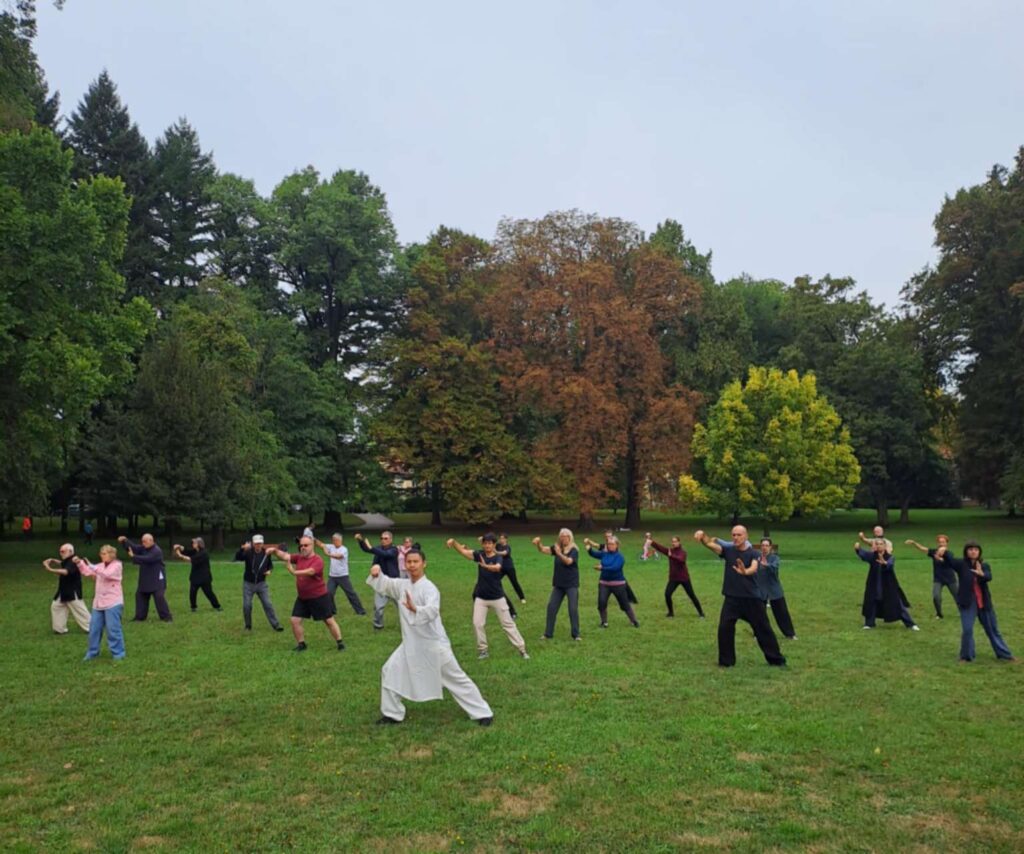
Not because it will explain everything — no article can do that. But because the most common reason people do not start Tai Chi is not lack of interest. It is not knowing where to begin, combined with a quiet worry that they might not be doing it right, or that their body might not be suited to it.
Both of those concerns are worth addressing directly.
You do not need to be ready
The most important thing to know about starting Tai Chi is that there is no prerequisite.
You do not need to be flexible. You do not need to be fit. You do not need to have any experience with martial arts, yoga, meditation, or any other practice. You do not need to be young — Tai Chi is, if anything, more valuable as the body ages, not less.
The Wudang tradition that forms the foundation of our practice is built on a principle that runs through all of Daoist thought: you work with what you have, where you are, as you are. There is no ideal starting condition. There is only the starting.
If you can stand — or even if you cannot, as many movements can be adapted to sitting — you can begin.
What to expect in the first session
Tai Chi looks simple from the outside. Inside, the experience is different.
In your first session, you will probably notice a few things:
Moving slowly is harder than it looks. The mind is accustomed to rushing. Asking it to stay fully present in a slow, deliberate movement is unfamiliar — and reveals, quickly, how much of the time we are elsewhere in our heads.
Balance is more complex than you assumed. Even simple weight shifts from foot to foot will reveal things about how you hold your body that you have never noticed before.
The breath matters more than you expect. Tai Chi is not just movement — it is movement coordinated with breath. Learning to breathe fully and naturally while moving is part of the practice from the beginning.
None of this should discourage you. These discoveries are the practice. The gap between where you are and some imagined ideal is not an obstacle — it is the material you are working with.
The Wudang Nine Forms
Our beginner programme is built around the Wudang Nine Forms — nine foundational movements drawn from the Wudang tradition, one of the most respected lineages in Daoist practice.
The nine forms are taught one at a time, over nine weeks. Each form builds on the last — so by the time you reach the ninth, you have not just learned nine separate movements, but developed a complete foundation of body awareness, balance, breath, and presence.
The forms are:
- Opening and Closing — the foundation of all movement
- Cloud Hands — softness and flow
- Single Whip — rooting and extension
- White Crane Spreads Wings — balance and expansion
- Brush Knee — coordination and weight transfer
- Playing the Lute — stillness within movement
- Step Back and Repulse Monkey — backward movement and awareness
- Wave Hands Like Clouds — continuous circular motion
- Closing Form — returning to stillness
You do not need to memorise this list. You just need to show up for the first one.
How to practise
A few practical notes for beginners:
Consistency matters more than duration. Twenty minutes every day will serve you better than two hours once a week. The nervous system learns through repetition — small, regular doses build the new patterns that Tai Chi is teaching.
Wear comfortable, flat-soled shoes or practise barefoot. You need to feel the ground. Thick-soled running shoes disconnect you from the surface beneath you, which is the opposite of what Tai Chi is developing.
Find a space where you can move freely and quietly. You do not need much room — a few square metres is enough. But you need enough mental space to be present. Practising with the television on in the background is not Tai Chi.
Do not push through pain. The instruction “no pain, no gain” has no place in Tai Chi. If a movement causes pain, make it smaller, slower, or gentler. The goal is never effort — it is awareness.
Be patient with yourself. Tai Chi is a practice in the original sense of the word — something you return to repeatedly, not something you complete. The benefits deepen over time, and the practice changes you gradually, in ways that are often more visible to others than to yourself.
The free introduction
Before committing to a full programme, we offer a free introductory session — a single 20-minute class introducing the first form.
No signup. No equipment. No experience required.
It is the simplest possible entry point. You watch, you follow, you feel what it is like to move this way. And then you decide whether you want to continue.
Most people do.
Start with the free intro class at Still Dao — no signup required. Or contact us if you have questions about whether Tai Chi is right for your situation.